


You’ve connected the jumper cables, and the dashboard lights are on, but the engine still won’t start when you turn the key.
That’s when many drivers discover that ordinary jumper cables or low-quality jump starters may not deliver enough power to handle a deeply discharged battery, or large-engine vehicles. A jump start isn’t a guaranteed fix. Understanding why your car won’t start—and choosing an emergency jump starter capable of handling demanding starting conditions—is key to getting back on the road and avoiding being stranded.
Cause 1: The Battery Is Too Dead for Your Jump Starter to Detect
When a car battery is deeply discharged, its voltage may drop so low that some emergency jump starters cannot detect it. Their built-in low-voltage protection may interpret the battery as disconnected and prevent power from being delivered.
This safety feature helps prevent accidental sparks and incorrect connections, but it can also leave you stranded when the battery is too depleted for normal jump-starting.
Fix: Choose an Emergency Jump Starter with Force Start Mode.
A force start mode allows you to manually activate the jump starter when a deeply discharged battery cannot be detected automatically. Before buying, check whether the device supports this function and follow the manufacturer’s instructions for safe operation. It can make the difference between a jump starter that simply detects a battery and one that can help when the battery is nearly dead.
Cause 2: Thin Cables and High Resistance (Where Cheap Power Is Lost)
A jump starter can boast high peak current on the box, but if its cables are thin or poorly made, much of that power is lost to resistance as heat. Thin-gauge wiring throttles current flow, preventing the high amperage your starter motor actually needs from ever reaching it.
The Fix: Prioritize Heavy-Gauge Cables and Heavy-Duty Clamps
Don’t just shop by peak current numbers—look at the hardware. Choose a jump starter built with thick, heavy-gauge copper wiring (preferably 8-AWG or lower) and robust, solid-copper clamps. Thicker cables lower internal resistance, ensuring maximum current delivery to the engine without overheating. (For instance, if you drive a 6.0L gas or 3.0L diesel vehicle, aim for a true 3000A+ peak unit paired with thick-gauge cables for optimal power transfer.)
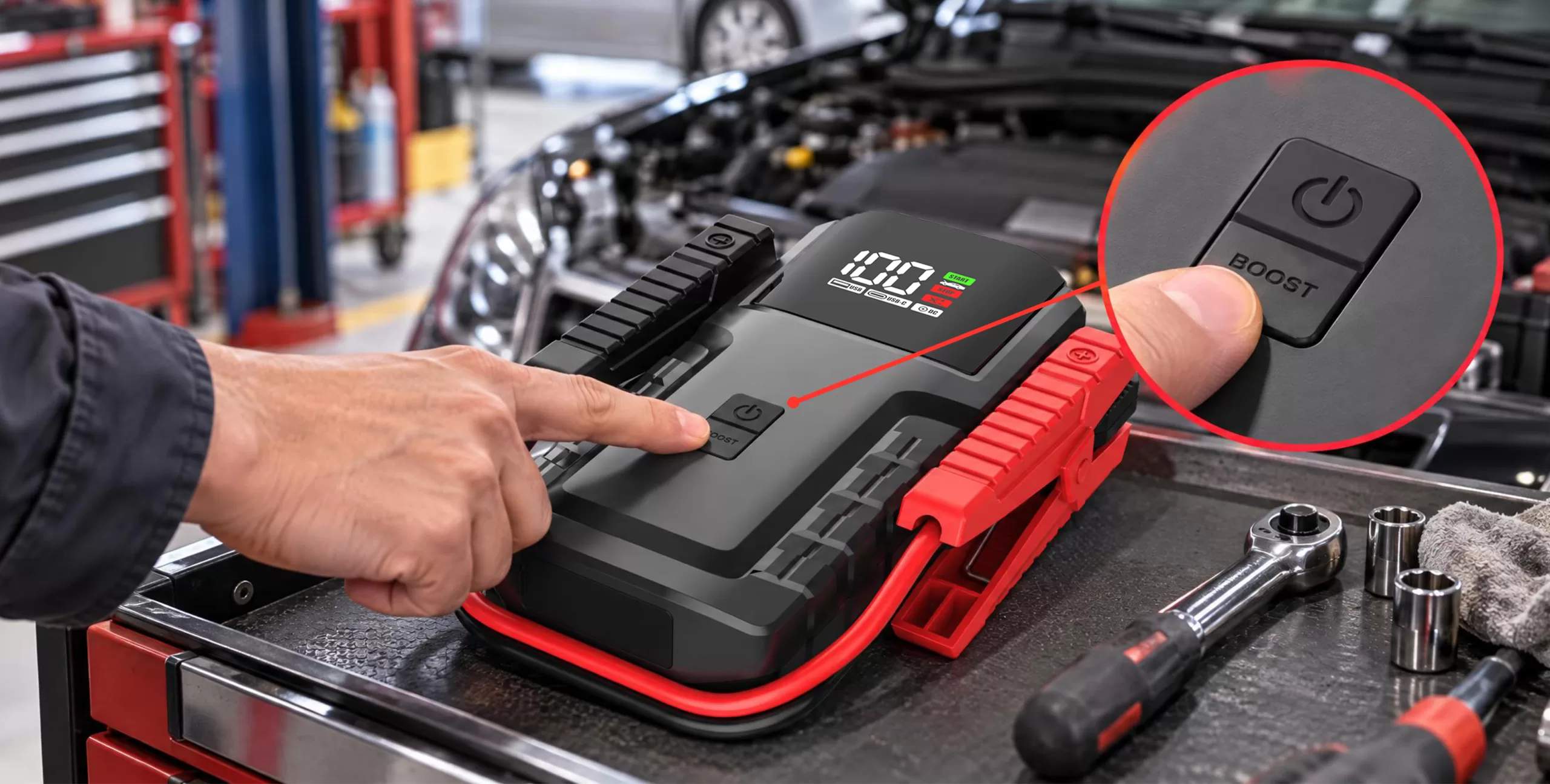
Car emergency jump starter showing switch clamps connection interface and force start operation under the engine hood JS-621
Cause 3: It Was Never the Battery in the First Place
This is where drivers waste the most time and effort. A car that refuses to crank could be suffering from a dead battery, a blown alternator, a faulty ignition switch, or a seized starter motor. A jump starter can only solve a battery issue. If your headlights are bright and full, but turning the key yields nothing more than a heavy single click—or dead silence—your starter motor is likely the real culprit, and no jump starter in the world can revive a dead starter.
The Fix: Diagnose Before You Act to Save Time & Hassle
Don’t blindly retry jumping a car that won’t respond. First, check your onboard electronics (bright lights usually mean the battery still has power).
Next, verify your jump starter itself is fully charged (smart units like the JS-621 feature an precise LCD screen so you can instantly rule out low tool power). If your jump starter is ready and connected properly but you only hear a metallic click from the engine bay, stop cranking—it’s time to call a tow or inspect the starter, saving yourself unnecessary frustration and potential electrical damage.
FAQs
-
Why can’t a jump start revive a completely dead battery?
Many units only turn on once they detect a minimum voltage. Below that, they stay off to protect you. A force-start function bypasses this, but it also bypasses some safeguards, so double-check polarity first.
-
My engine just clicks even with a jump. Is the battery the problem?
Probably not. A single click, or rapid clicking, with a good power source often points to the starter, the solenoid, or a corroded connection. Clean the terminals first, then have the starter tested.
-
How long should I crank, and when should I disconnect?
Keep each attempt short and rest between tries. With the JS-621, take the clamps off within 30 seconds after the engine starts. If the engine fails to start after several attempts, stop. Repeated cranking heats up the cables and clamps, and the real problem is likely elsewhere.