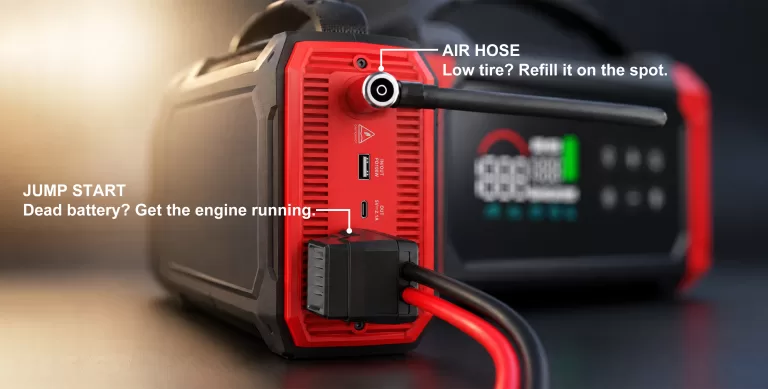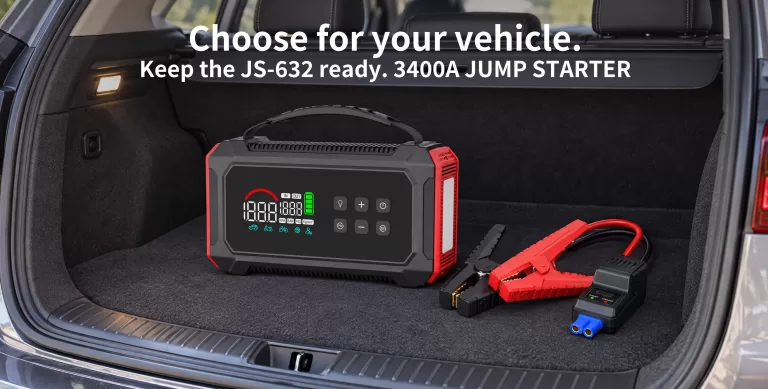



A tire inflator with jump starter puts two roadside fixes into one portable unit: it restarts a vehicle whose battery can no longer crank the engine, and it brings an under-inflated tire back to the right pressure. Many models also add emergency features such as an LED flashlight and an SOS or strobe light, which help most when a breakdown happens after dark or on a poorly lit roadside.
Do You Need a Tire Inflator and Jump Starter Combo?
For everyday passenger cars, SUVs, and light trucks, a combo makes sense when you want one compact emergency tool instead of several. But “multi-function” does not mean “right for every vehicle.” Start with the two core jobs, then treat the extras as tie-breakers:
Starting capability: Does the unit’s starting output suit your engine size and fuel type, gasoline or diesel? Peak amps alone do not answer that.
Inflation performance: Can the compressor reach your recommended tire pressure at a practical speed? Maximum PSI is a pressure limit, not a measure of how quickly a tire fills.
Emergency features: A flashlight lets you see battery terminals and tire valves in the dark, and an SOS or strobe light makes a stopped vehicle easier for other drivers to notice. Neither replaces the core specs, but they can separate two otherwise similar units. Keep in mind that every function draws from the same battery, so the more you use the extras, the less stored energy is left for starting.
A combo is the better fit when your use is occasional and your vehicle is a typical personal car. Separate tools may serve you better if you drive a larger engine or a heavy vehicle, expect to inflate tires regularly, or already own a reliable inflator.
Not every “multi-function” unit is built the same way, and brands define “4-in-1” differently.The sections below show how to judge starting power, inflation, battery, safety, and extras side by side, so you can choose the right model for your needs.
How to Choose Jump Starter with Air Compressor: 5 Criteria That Decide Which One Works
The five criteria below are ranked by the cost of getting the choice wrong—starting with whether the unit can reliably start your vehicle, then whether it stays ready and inflates tires effectively, before considering safety and added features. This order helps separate the specifications that determine whether a jump starter air compressor will actually work for your vehicle from those that mainly improve convenience.
| Criterion | What to check | How to compare fairly | Red flag |
|---|---|---|---|
| Starting reliability | Voltage, engine size, fuel type, and cold-weather starting results. | Same engine type, battery state, and temperature, with repeated attempts. | Peak amps with no engine or temperature stated. |
| Battery and standby | Capacity, recommended recharge interval, and a clear battery-level indicator. | Follow the manual’s recharge interval and full recharge time, and note the storage conditions. | “Maintenance-free” with no conditions given. |
| Inflation performance | Timed fill, gauge accuracy, hose seal, and duty cycle (how long it runs before it must cool). | Same tire size and same pressure range, for example 30 to 35 PSI. | Maximum PSI as the only inflation spec. |
| Safety protection | Reverse-polarity, short-circuit, over-current, and over-temperature protection, plus certifications and fault indicators. | Look for a named list of protections, not a general claim. | “Multiple protections” with no list. |
| Extras worth paying for | Pressure display, preset with auto shutoff, hose connector; flashlight, SOS mode, USB output. | Does it help the two core jobs, and how much battery does it use? | Feature count used as the main selling point. |
The 30 to 35 PSI range is an example of a fair comparison, not a test result.
Quick takeaway
- Starting power: judge it by evidence, not peak amps. A claim is useful only when it names the engine, battery condition, and temperature.
- Battery and standby: treat standby as a schedule, not a promise. Follow the manual’s recharge interval, since every function draws from the same battery.
- Inflation: compare timed fills and duty cycle on the same tire size and pressure range, not maximum PSI.
- Safety: prefer documented protections over a vague “multiple protections” line, because they matter more than any extra feature.
- Extras: count them only if they help the two core jobs, and treat the flashlight and SOS mode as tie-breakers, not reasons to buy.
Best 4-in-1 Jump Starter with Air Compressor:What the “4” Really Means
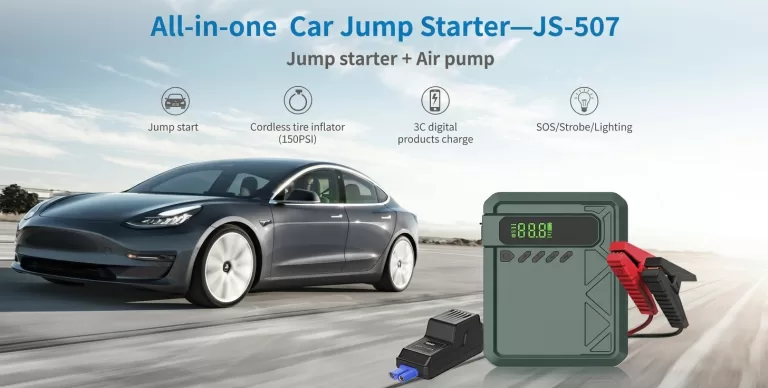
A 4-in-1 jump starter with air compressor combines four functions: jump starting, tire inflation, power-bank charging, and LED lighting. CARKU lists the JS-507 with this combination. The label describes which functions are included, not a performance grade, and not every model offers the same capabilities.
Compared with a standard jump starter air compressor, the two added functions are charging and lighting, not stronger starting output or faster inflation. The best 4-in-1 model is therefore the one where every extra has a clear use without weakening the two core jobs. Because all four functions draw from one battery, heavy use of the extras leaves less energy for starting.
For a portable tire inflator and jump starter kept in a trunk or glovebox, also check how the cables and air hose store in the kit. Anchor the comparison to specifications rather than the label: CARKU lists the JS-507 with 1,500A peak current and a 150 PSI compressor, weighs 670g, and the JS-558 with 3,250A peak current, a 160 PSI compressor, and 30W USB-C PD charging. These are specification differences, not proof that the higher-numbered model is better for everyone, and a higher maximum PSI does not mean faster inflation.
The model comparison below separates starting and inflation capability from charging, lighting, and accessory differences, so you cansee what each option adds.
Carku JS-507 vs JS-558: Which One Fits Your Vehicle?
The JS-507 is the lighter, more compact option, while the JS-558 has a larger battery and higher advertised peak current at the cost of size and weight. The right choice depends on your engine, tire size, and how you use the unit.
Select the CARKU JS-507 if: You drive a daily passenger car or crossover (e.g., Toyota RAV4, Honda Civic) and prioritize a lightweight, space-saving design that easily fits under a seat or in a glovebox for routine roadside peace of mind.
Select the CARKU JS-558 if: You operate large-displacement gas engines or diesel trucks (e.g., Ford F-150, Chevrolet Silverado), carry heavy tire loads, or operate in extreme freezing conditions where maximum cranking current and rapid airflow volume are critical.
Table: JS-507 and JS-558
| Latest Model | JS-507 | JS-558 |
| Dimension | 122.2*164.2*46mm | 230*112.5*124mm |
| Weight | 670g | 1.7kg |
| Max inflation pressure | 150PSI | 160PSI |
| Peak current | 1500A | 3250A |
| Battery capacity | 37Wh | 88.8Wh |
| Operating Temperature | -20℃~60℃ | -20℃~60℃ |
For a jump starter with air compressor, the question that matters is what the battery can still do after a hot trunk, a cold morning, or four tires of inflation.
What CARKU documents about the JS-558 battery
CARKU lists the JS-558 with LiFePO4 battery cells and a battery management system (BMS). The datasheet names 10 protection functions:
CARKU rates the unit for operation between −20°C and 60°C (−4°F to 140°F). The product datasheet page provides relevant battery certifications and transport documentation required for different markets, including the UN 38.3 test report.
These are manufacturer ratings and documents. A temperature rating describes the range a unit is designed for, not how well it starts an engine at those temperatures.
What we tested
JS-558 Internal TEST:
JS-507 Internal TEST:
About CARKU
Founded in 2011 and headquartered in Shenzhen, CARKU provides OEM/ODM solutions and its own-brand products across jump starters, portable power stations, and starting batteries. It reports 852 global patents as of October 2026 and exports to more than 50 countries and regions.
FAQs
1. Can a tire inflator jump starter fix a flat tire?
No. A tire inflator restores air pressure; it cannot physically repair tire damage. When it helps: Replenishing pressure lost to seasonal drops, valve stem leaks, or slow punctures to allow safe transit to a service center.
2. Is a jump starter with air compressor better than separate tools?
Neither is universally superior; selection depends on trunk space efficiency versus single-task duty cycle. A combo high-tier systems mitigate power-sharing concerns through cell budget optimization. In CARKU testing at 20℃, after inflating four 205/55R16 tires from 25 to 35 PSI, the JS-558 retained sufficient reserve capacity to perform 3 consecutive starts on a 2.0L gas engine.
3. Can it start a motorcycle, boat, or RV?
Only if the voltage and engine size match. The JS-558 is a 12V unit, so it suits 12V motorcycles, boats, and RVs within its rated engine size, but it should not be used on a 24V system. Check the engine size and fuel type on the datasheet and the manual of your vehicle before connecting.