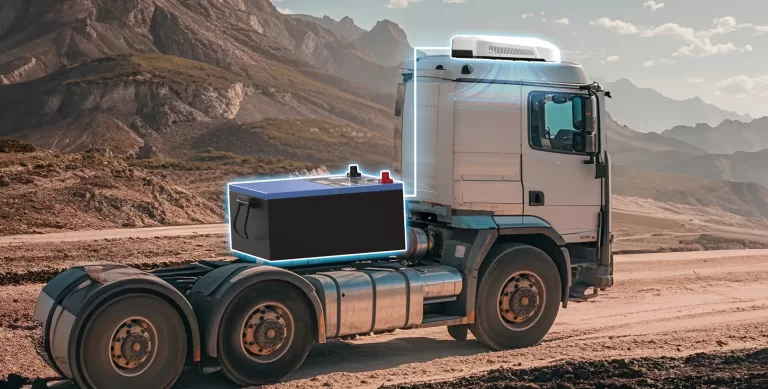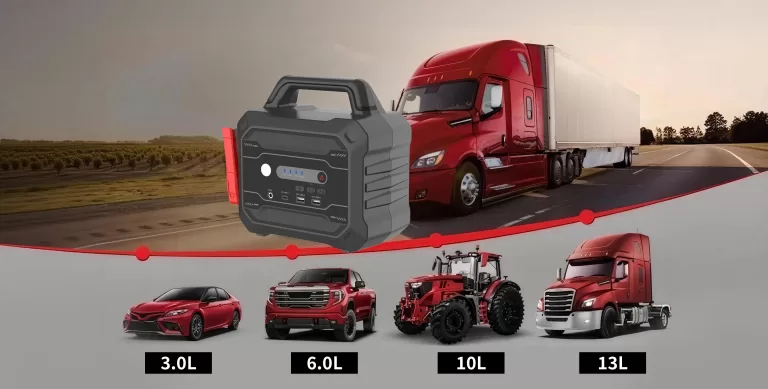



Speed: Capacitor jump starters deliver instant cranking power on demand, while lead-acid units depend on stored charge level and may respond more slowly, especially in cold conditions.
Size: Lead-acid jump starters typically offer higher energy capacity at a lower weight per watt-hour, while capacitor-based systems trade compact energy density for high-current discharge capability.
Life:The lifespan of a jump starter is another area where capacitors excel. A capacitor jump starter can handle thousands of charge and discharge cycles without significant degradation, making it highly durable for frequent use. In contrast, lead-acid battery jump starters have limited cycles and can experience sulphation and swelling if deeply discharged or poorly maintained. For long-term reliability, choosing a capacitor jump starter ensures more consistent performance over time.
Cold weather performance:Capacitor jump starters perform exceptionally well in cold weather because they do not rely on chemical reactions. Unlike lead-acid batteries, whose internal resistance increases sharply at low temperatures, capacitors store and release energy through physical charge separation. This allows a capacitor jump starter to deliver instant high current even in extreme cold conditions, ensuring reliable engine starts when traditional lead-acid jump starters struggle or fail.
Power output:In terms of sustained power output, lead-acid batteries are stronger. However, for short, high-current bursts such as engine starting, super-capacitors can match or even outperform lead-acid batteries.
|
Feature |
Lead-acid Jump Starter |
|
|
Speed |
Instant response, delivers current immediately |
Slower response due to chemical reaction |
|
Size / Weight |
Compact and lightweight, easy to carry |
Large and heavy, poor portability |
|
Life / Durability |
Extremely long cycle life (thousands of cycles) |
Limited cycles, degrades with deep discharge |
|
Power Output |
Very high instantaneous current, ideal for engine start |
Strong sustained output, higher total energy |
|
Cold Weather Performance |
Stable performance in extreme cold |
Output drops significantly in low temperatures |
So which one is better? At this point, you should already have a good idea of how these two options compare.
Super-capacitor Technology Advantages
Extremely low internal resistance, enabling high power output from minimal energy
Ultra-fast recharging, typically within 30 seconds to 3 minutes
Non-chemical energy storage, using physical charge and discharge processes
Exceptional cycle life, capable of up to one million charge–discharge cycles
Safe deep-discharge capability, remaining at 0 voltage for years without degradation
JS629 Super-Capacitor Jump Starter Advantages
Extended service life, benefiting from super-capacitor technology
Built-in LED functions, including SOS, strobe, and continuous lighting
Reliable starting in extreme cold, operating down to –45 °C
Portable outdoor design, featuring an integrated LED clamp for emergency use
The JS629 leverages the strengths of super-capacitor technology to provide a highly reliable, maintenance-free, and portable solution for vehicle starting.
Lead-acid Jump Starter Limitations
Lead-acid jump starters are known for strong cranking power and a long history of use. However, their limited cycle life (200–500 cycles) requires frequent maintenance. Containing liquid sulfuric acid electrolyte, they must be handled carefully, often resulting in higher long-term maintenance and repair costs.
Conclusion: Which Jump Starter Should You Choose?
Pure vehicle starting: A super-capacitor jump starter is ideal, offering instant high-power output, outstanding portability, and exceptionally long service life with minimal maintenance.
Vehicle starting & charging electronics: A LiFePO₄ battery jump starter is more suitable, providing reliable starting performance and energy storage for devices, while still maintaining good portability and a long lifespan compared to traditional lead-acid alternatives.